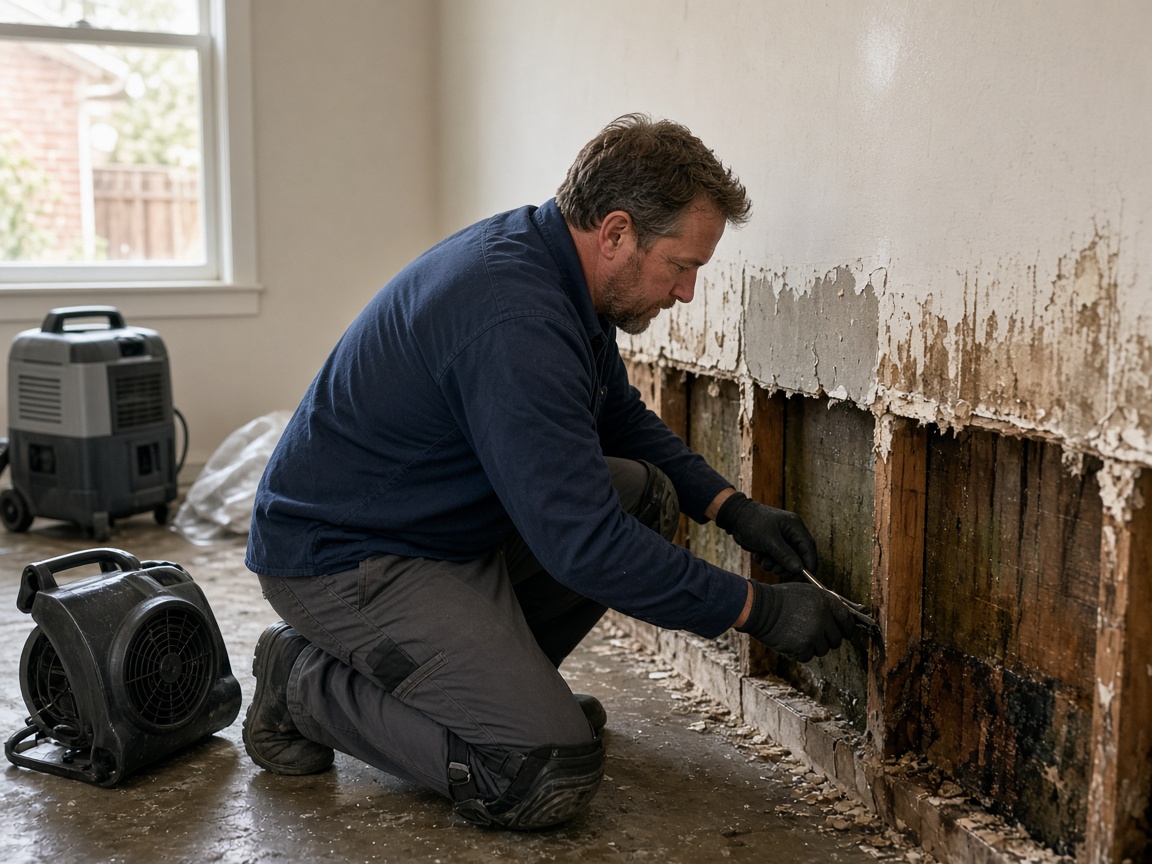
Fort Worth sits in a humid subtropical climate where summer humidity often exceeds 70 percent, allowing moisture to linger in wall cavities and subfloors long after visible water is gone. Older stock in Arlington Heights and the Cultural District frequently features plaster over lath or early drywall that absorbs water differently than modern materials, requiring targeted drying rather than simple fans. Homes near the Trinity River or in low-lying pockets of the Stockyards can see groundwater intrusion during heavy rains that the mild winters do little to evaporate.
Tarrant County soil is mostly clay that expands and contracts with moisture cycles, stressing foundations and creating hairline cracks that let water migrate under slabs. Properties around TCU and Mansfield often have pier-and-beam construction where crawl spaces trap humidity, turning small roof leaks into widespread subfloor damage. Technicians must account for these conditions when placing dehumidifiers and air movers to prevent secondary mold growth that can appear within 48 hours in local summer temperatures.
Water extraction in Fort Worth neighborhoods must also consider the mix of historic and post-war homes where electrical systems and insulation types vary widely. Removing standing water from Sundance Square commercial buildings or Stockyards residential properties requires equipment sized for the actual square footage and material porosity rather than generic formulas. Proper documentation of moisture readings at multiple depths helps avoid callbacks when hidden pockets remain in brick veneer or attic insulation common throughout the area.
Technician insight
In Fort Worth the thing that catches most people out with water damage repair is how quickly humidity in the crawl spaces of 1950s Arlington Heights homes turns a small roof leak into widespread subfloor rot before winter even arrives.
Crawl Space Leak Near TCU Stadium
A homeowner in a 1960s pier-and-beam house near TCU Stadium noticed musty air after heavy rain. Inspection found standing water in the crawl space from a shifted downspout and clay soil directing runoff under the home. Extraction and targeted drying prevented mold from spreading into the living area above.
Water Damage Repair Services We Offer
✓Emergency Water Extraction
Rapid removal of standing water from basements, crawl spaces and living areas using truck-mounted pumps sized for Fort Worth humidity levels.
✓Structural Drying and Dehumidification
Placement of commercial dehumidifiers and air movers to pull moisture from plaster, drywall and subfloors common in Arlington Heights homes.
✓Slab Leak Detection and Repair
Locating and addressing leaks under concrete foundations typical in TCU and Mansfield neighborhoods before they migrate into finished spaces.
✓Mold Prevention After Water Intrusion
Antimicrobial treatment and targeted drying to stop mold growth accelerated by Tarrant County summer humidity in older Stockyards properties.
✓Crawl Space Water Removal
Extraction and drying of moisture trapped under pier-and-beam homes prevalent around the Cultural District and Downtown edges.
Water Damage Repair Cost in Fort Worth, TX
| Service | Typical Range | What Affects It |
|---|---|---|
| Water Extraction | $600–$1,800 | Varies with volume and whether crawl space or slab access is needed |
| Structural Drying | $800–$2,500 | Depends on square footage and duration required in humid summer conditions |
| Slab Leak Repair Coordination | $400–$1,200 | Includes detection and temporary mitigation before permanent fix |
| Mold Prevention Treatment | $300–$900 | Based on square footage and product application needed |
Ranges are typical for Fort Worth, TX and confirmed with an exact written quote before any work starts.
How it works
- 1
On-Site Assessment
Technician inspects affected areas in the specific Fort Worth neighborhood, measures moisture levels in walls and floors, and identifies hidden water paths common to local construction.
- 2
Water Removal
Extraction equipment removes standing water while protecting surrounding finishes in homes near the Stockyards or TCU Stadium.
- 3
Drying And Monitoring
Industrial drying equipment runs with daily moisture readings until levels return to normal for Tarrant County climate conditions.
- 4
Restoration And Cleanup
Repairs to damaged materials and final cleaning to restore the property without leaving residual humidity that could cause issues later.
Pricing
Upfront quotes provided after inspection; cost depends on water volume, affected materials and access in older Fort Worth homes.